Pepitedata
  • Home
  • Audits
  • Expert Call
  • About
  • Blog
  • Contact

LOSF

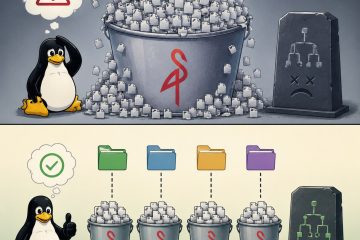
Two panels. Top: a single MinIO bucket overflowing with small files, a worried Tux, and a dead directory tree on a tombstone. Bottom: the same objects split across four prefix-partitioned buckets under separate folders, with a healthy green directory tree.
MinIO

MinIO on XFS: Inode Exhaustion and Prefix Design for Lots of Small Files

MinIO has no NameNode. It puts the namespace on XFS as real directories and xl.meta files. On Lots of Small Files that means you can exhaust inodes while df -h still looks fine, and a flat leaf can stall PUT, LIST, scanner, and ILM together. Here is the on-disk model, the inode math, and a prefix recipe that keeps XFS inside a regime you can operate.

By Julien Laurenceau, 3 weeks2026-07-27 ago
A penguin overwhelmed by an avalanche of tiny blue small files spilling out of index drawers and overflowing a bucket, illustrating MinIO under a lots-of-small-files workload
MinIO

MinIO and Lots of Small Files: Why It’s Not a Database, and Why That Matters

MinIO was not built for Lots of Small Files (LOSF). No global index, no read repair, and a scanner that can take weeks to notice silent corruption. Here is what breaks, why tiering makes it worse, and when you should use a database instead.

By Julien Laurenceau, 2 months2026-06-29 ago
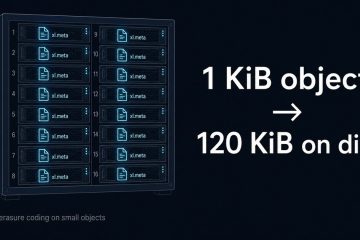
Diagram: MinIO erasure-coding storage inflation on small objects — per-drive xl.meta metadata replicated across the erasure set
data

Stop using MinIO as a NoSQL database — why S3 object stores collapse on small-file workloads

Two MinIO platforms, same root cause: used as a NoSQL store. Field notes on LIST IOPS, XFS directory limits, scanner & heal SLAs, the erasure-coding storage-efficiency inversion on small objects, and why Apache Cassandra (or Ceph) is the right answer on-prem in 2026.

By Julien Laurenceau, 3 months2026-05-17 ago
  • Privacy Policy
  • Mentions légales
  • CGV
  • Cookies
Hestia | Developed by ThemeIsle