
DHH said something on the Lex Fridman podcast that most of the software industry would not dare repeat. He said that for some problems, programmers do worse with AI coding tools than people who cannot code at all.
Update, September 2026: the first controlled data on this question is in. A preregistered ETH Zurich study found that CS knowledge, not writing skill, predicts vibe coding success. I wrote a follow-up: The first vibe coding data complicates DHH’s claim.
He did not say it as a hot take from the sidelines. David Heinemeier Hansson created Ruby on Rails, has shipped software for over two decades, and builds products with AI agents every day. When a person with that track record tells you your experience can work against you, it is worth understanding what he said and what he did not. The headline version flattens a more interesting argument. And the flattened version hides the part that matters most for anyone leading an engineering team today.
What DHH actually said
DHH said that for some problems, programmers are worse than non-programmers at agentic engineering. The claim came out of a direct question. Fridman asked whether such problems exist, where agentic engineering means driving AI agents that write the code themselves. DHH answered:
“100%. … There’s a lot of programmers who are not very good product managers. Software is product management. What should it do? Who should it do it for? How should it do it? … All of those skills are not easily or equally distributed across all programmers.”
DHH, on the Lex Fridman podcast
His conclusion: now that agents handle implementation, those are the skills the work actually needs. Read that carefully. He is not saying that knowing how to code makes you bad at using AI. He is saying the differentiating skill has moved. What you contribute is deciding what to build, for whom, and in what order. Many experienced programmers never developed that skill because they never needed it.
His account of his own experience is more uncomfortable than the headline. He says that for a while, his own depth of programming knowledge counted against him, because he kept instructing the agents the way he would have prescribed a path. The agents produce better results when you tell them what problem to solve and get out of the way.
Two things temper the claim. First, he was deliberately steelmanning the strongest version of the argument, not reporting a settled position. Second, his own practice contradicts the strong reading. He still reviews the individual lines of anything critical in the model layer of his current project, even though he has written none of its shipped code by hand. He describes a period at Basecamp when designers vibe-coded freely and the result wrecked the system’s architecture, requiring manual cleanup by hand. He distinguishes vibe coding, where you never look at the implementation, from programming, where you do.
So the fair version of his claim is narrower than the headline: for problems where product sense and taste dominate, an experienced programmer who over-specifies can get worse results than a non-programmer who simply describes what they want. Still striking. Just not the blanket one.
Amplifier, not equalizer
AI amplifies existing judgment rather than equalizing developers, and a recent newsletter essay makes the complementary case. “AI is making bad developers worse, and good developers better” by Faturoti Kayode argues that since everyone can now generate code, a developer’s advantage is no longer producing code but understanding and taking responsibility for it. Its mechanisms describe things I see in audits.
AI removes the friction that used to force learning: “Before AI, a weak developer would eventually jam what’s bigger than them.” Bad judgment scales: “The volume of their output increases. Their ability to judge it does not.” And confidence inflates faster than competence.
Put the two arguments side by side and they look opposed. The newsletter says experience is exactly what converts AI speed into good outcomes: strong developers use AI “to remove work, not thought”, and their knowledge gives the AI direction. DHH says experience can distort how you instruct the agent, because you prescribe a path when you should describe a problem.
They are not opposed. Both rest on the same distinction: the skill that matters is deciding and judging, not typing. The newsletter’s weak developer is someone with the title who escapes thinking. DHH’s disadvantaged programmer is someone who cannot stop thinking in implementations. Same failure mode: judgment stops exactly when it is the only thing left to contribute.
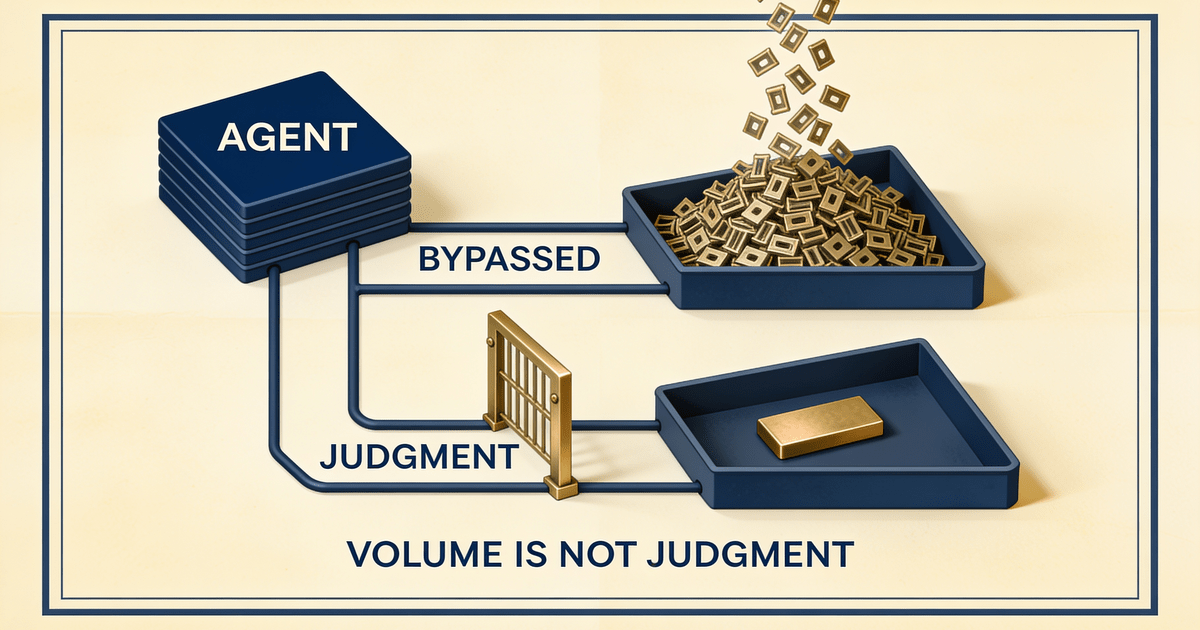
Where they genuinely disagree is on whether experience reliably compounds. The newsletter’s author assumes it does and offers no data. DHH’s answer is more interesting: experience compounds, but only if you notice when your habits stop paying. His term for it was humility: treating the agent’s answer as the better one more often than not.
What this means for teams adopting AI
Adopting AI in an engineering team is a hiring and judgment problem before it is a tooling problem. If you lead an engineering organization, neither piece is a prediction about tools. Both are arguments about what to select for. Three practical implications:
- Hiring criteria shift. When agents write most of the code, product sense, system judgment and the ability to verify work you did not write become the scarce skills.
- Expertise needs an off switch. Your senior people are the most likely to over-constrain agents. The failure looks like productivity: detailed specs, precise instructions, mediocre results. Make it acceptable to hand an agent a vague problem and see what comes back before dictating the design.
- Understanding stays non-negotiable. DHH reviews critical code. The newsletter’s test is blunt: if you cannot explain the code without reopening the chat, “you’re a dummie”, in the author’s words. This is the same mechanism I see when an optimization relocates a bottleneck instead of removing it.
There is also a defensive reading. The newsletter notes that developers who refuse AI entirely are “preparing for a world that no longer exists.” Fair. But DHH shows the opposite failure: adopting the tool while refusing to update what you contribute to it. Both are skill gaps. Only one feels like competence from the inside.
The takeaway
The takeaway: the headline is clickable but wrong in its strong form. DHH did not say programmers are worse at AI coding than non-programmers. He said the skills that win in the agentic era are product judgment and taste, those are unequally distributed, and deep implementation expertise can distort how you work with agents if you let it.
The question to ask about your team is not “are we using AI?” but “who is exercising judgment over what the AI produces?” If the answer is nobody, or only the person with the most years of writing code, no tool will close that gap.
Experience still compounds. But only for people who notice when it stops being an asset. AI just made the bill arrive faster.
Frequently asked questions
Did DHH say programmers are worse at AI coding than non-programmers?
Not in the strong form. Asked directly, he answered 100% to a question about problems where programmers do worse than non-programmers at agentic engineering, and he framed the answer as deliberate steelmanning. The claim covers problems where product sense and taste dominate, not all programming work.
What is agentic engineering?
Driving AI agents that write code themselves, instead of writing every line by hand. The skills that matter shift from implementation toward deciding what to build, for whom, and in what order, and toward judging what the agent produces.
What did DHH mean by vibe coding?
Building with AI without ever looking at the implementation. He distinguishes it from programming, where you do review the code. He describes a period at Basecamp when designers vibe-coded freely and the result wrecked the system’s architecture and required manual cleanup by hand.
Why can over-specifying instructions hurt AI coding results?
Because implementation experience pushes you to prescribe a path when the agent works better from a described problem. DHH says his own depth of programming knowledge counted against him for a while for exactly that reason.
What skills matter most when AI agents write the code?
Product judgment, system judgment and the ability to verify work you did not write. The newsletter essay in this article makes the complementary point: output volume rises, the ability to judge it does not, and confidence inflates faster than competence.
Should senior engineers stop reviewing AI-generated code?
No. DHH has written none of the shipped code of his current project by hand and still reviews the individual lines of anything critical in the model layer. Understanding stays non-negotiable: if you cannot explain the code without reopening the chat, you are not exercising judgment over it.
Related posts
- After Coldcard, AI Found 1,029 Bugs. Censored Models Found None.
- Local LLMs, Political Bias, and Why llama.cpp Still Matters
- Benchmark Best Practices, Part 1: Amdahl’s Law Caps Your Scaling Claim
I audit data and AI infrastructure for a living, and I keep meeting the other side of this gap: teams adopt agents faster than they adopt verification. If your platform runs on changes nobody fully reviews, that is exactly the kind of thing a data platform audit surfaces. Book a 15-min intro call if you want to talk through your setup.
0 Comments