Pepitedata
  • Home
  • Services
  • Audits
  • Expert Call
  • About
  • Blog
  • Contact

Julien Laurenceau

A stacked stone ziggurat with two loose blocks waiting beside it
ceph

Ceph RGW Accounts in Tentacle: Plan the Identity Model

Ceph tenants and accounts solve different problems. Separate the Tentacle upgrade from account adoption, then test ownership, IAM and notifications.

By Julien Laurenceau, 5 minutes ago
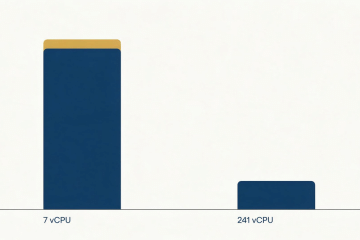
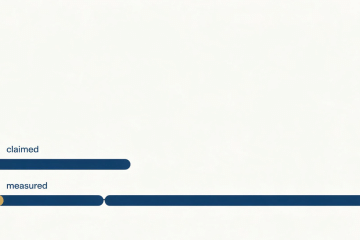
Two bars comparing a short claimed recovery duration with a far longer measured one interrupted by a waiting gap
data

Data Platform Resilience: RTO, RPO and Replication in Practice

A DR document states minutes and megabytes. Replication architecture delivers a convergence time, a single-copy window and a failed tail. This guide maps what actually decides your RTO and RPO.

By Julien Laurenceau, 30 minutes ago
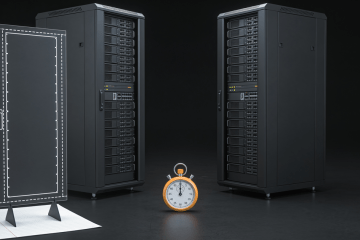
A paper cutout server rack beside a real rack, with a stopwatch between them
data

RTO and RPO for Data Platforms: Test the Recovery Path

RTO and RPO are measurable recovery objectives, not labels on an architecture diagram. Build a failure matrix and test the complete recovery path.

By Julien Laurenceau, 48 minutes2026-09-30 ago
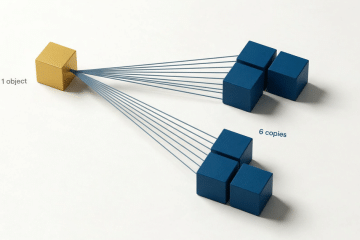
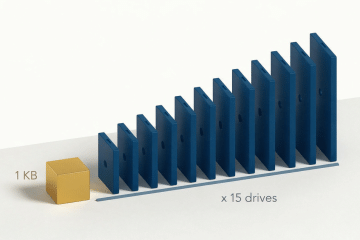
A one kilobyte object fanning out into fifteen metadata copies, one per drive of the erasure set
object storage

Object Storage for Data Platforms at Scale

A production guide to running object storage at scale: why object count is a capacity axis, how prefix design and the background scanner set your real SLAs, and how to choose engines, media and release channels.

By Julien Laurenceau, 6 hours ago
An open duct in a stone chamber holding a single file of evenly spaced glowing cubes, one entering and one leaving
data

Benchmark Best Practices, Part 2: Little’s Law Ties Throughput, Latency and Concurrency Together

Second in my benchmark best practices series. Little’s law checks that throughput, latency and concurrency describe the same system, exposes the load generator’s ceiling, and turns a latency budget into a sizing requirement.

By Julien Laurenceau, 1 week2026-09-22 ago
Three server racks labeled A, B and C joined by a closed oval conveyor loop where one amber crate labeled 405 circulates endlessly, never docking at the open slot on rack C
MinIO

MinIO delete-marker convergence: how the Silo fork fixed the 405 replication loop

The 405 storm had three root defects in the delete-marker path. PR #162 fixed the first attempt; PR #184 fixes retries, purge status and MRF healing in the Silo fork.

By Julien Laurenceau, 2 weeks2026-09-15 ago
Two industrial conveyor lanes in dark graphite, the upper lane continuous and the lower lane cut short with a small amber end cap
MinIO

MinIO Community in Production: Assess the Risk You Are Running

MinIO Community Edition has had no release since October 2025 and the repository is archived. Three CVEs will never be patched there. Here is how to assess what your cluster is actually exposed to, and where the maintained community fork fits in.

By Julien Laurenceau, 2 weeks2026-09-14 ago
A navy vending machine labeled GLM 5.3 FLASH and FREE on a cream background, with a pipe from its back feeding a tank labeled PROMPT LOGS
AI

Your AI Supply Chain Is a Production Dependency. Audit It Like One.

Two movements meet: AI is getting production responsibilities, and production data is flowing through AI. Anthropic’s September report, malicious routers, training data provenance and model drift show what to verify before an AI reaches production.

By Julien Laurenceau, 3 weeks2026-09-12 ago
Two MinIO sites locked in a closed replication loop: delete markers stamped 405 circulate endlessly between two racks, piling up instead of converging
MinIO

MinIO site replication bug: how 684 million HTTP 405s exposed the delete-marker loop

HEAD probes on delete markers answer 405 and replication counts that as success. 20M stuck versions turned the loop into 684M useless requests in 48 h.

By Julien Laurenceau, 3 weeks2026-09-06 ago
Classic CS textbooks beside a monitor where parallel AI agent threads converge into one glowing review queue
AI

The First Vibe Coding Data Is In, and It Complicates DHH’s Claim

A preregistered ETH Zurich study found that computer science knowledge, not writing skill, is the strongest predictor of vibe coding success. Here is what that does and does not say about DHH’s claim that programmers can be worse at AI coding than people who cannot code.

By Julien Laurenceau, 3 weeks ago

Posts pagination

1 2 … 5 Next
  • Privacy Policy
  • Mentions légales
  • CGV
  • Cookies
Hestia | Developed by ThemeIsle