I reduced my Claude Code token usage from 17% to 5% of my Claude Max weekly limit per 12 hours of autonomous work. Three things changed together: the harness, the model split and the length of the review loop. The largest surprise was the harness. Maki, an MIT-licensed open source coding agent written in Rust, replaced Claude Code to cut LLM token usage on my issue queue.
This is a field report from one side project. It is one measurement with several variables, and I will show you exactly where it stops proving anything.
Key results from this field report:
- Measured result: Claude weekly usage fell from 17% to 5% per 12 hours, a 71% drop.
- Weekly projection: a loop running all week went from 238% to 70% of the Claude weekly limit.
- Main caveat: I changed the harness, vendor mix, round limit and effort levels together, and part of the work moved to my ChatGPT plan.
- Account risk: Claude subscription login in Maki is possible, but I do not recommend it because of Anthropic’s terms.
What did Matt Pocock’s skills change in my workflow?
Matt Pocock’s Skills For Real Engineers turned my side project into an issue-driven pipeline. The agent picks up GitHub issues, implements them, reviews its own work and reports leftovers. I gained confidence in code review, clear limits on what the LLM decides alone, and an async discussion channel through GitHub issues.
The productivity gain was large. I also started to spawn fresh context as often as possible, with subagents and subsessions for each unit of work. A fresh session carries less history, so each turn costs less and the model stays focused. Matt Pocock publishes more of this material on AI Hero.

Why did this workflow burn my Claude Max quota?
An autonomous loop consumes quota around the clock, and every review round reloads code into a new context. My earliest setup emptied Claude Max in less than a day, although I never used a model stronger than Opus 5.5 at high effort. Usage resets and the $100 free API credit from Claude disappeared the same way.
Better process had raised my throughput and my token bill at the same time. Fresh context was not enough on its own. The later Claude Code goal loop that serves as my baseline below still used 17% of my weekly limit in 12 hours. I needed to look at what the harness sends to the model on each turn.

Why replace soft rules with linters, tests and CI?
Linters, tests and CI enforce a rule on every run, while a sentence in AGENTS.md depends on agent judgment and costs tokens each time it loads. I took this idea from poteto, the author of pstack. I removed as much soft language as possible from my AGENTS.md and docs, then moved the rules into checks.
I read poteto’s guide to pstack, but I did not install pstack, because it felt too Cursor-centric for my setup. It does document a Claude Code install path. Its principles travel well without the plugin. In an October 2026 post, poteto ranks where your effort should go:
- Codebase improvements: architecture, types, invariants and boundaries that remove a class of problem.
- Static analysis: lint rules, tests, CI and formal verification.
- Prose: comments, rules, AGENTS.md and skills, used minimally.
- Human review: the hardest layer to scale.
Banning code comments was the change that surprised me most. Poteto’s argument is that “agents love copying what already exists“. One comment that explains a temporary workaround gives the next agent a precedent for another workaround. Poteto keeps the rare comment that must exist, such as a note on a browser quirk. I now treat every other comment as a defect.
How does Maki reduce token usage?
Maki reduces token usage by keeping file contents and tool output out of the model context. It sends code skeletons instead of full files, runs bulk work in a sandbox, loads tool definitions on demand and routes subagents to cheaper model tiers. I heard about it from my friend Emile Heitor during local inference tests with StrataLLM.
| Maki feature | What it does | Figure published by Maki |
|---|---|---|
index | Parses 15 languages into imports, types and function signatures with line ranges | Costs 59 tokens per turn, saves 224 on reads |
code_execution | Runs a sandboxed Python script, and only printed output enters the context | About 40k tokens down to about 30 in its example |
tool_search | Hides MCP tool definitions behind one search tool | n/a |
task | Assigns each subagent a weak, medium or strong model tier and returns a summary | n/a |
| Compaction | Drops images and thinking blocks first, then summarizes old turns | n/a |

Maki also shows token count, cost and model in the status bar. That visibility matters during a long run, because you see a costly pattern while it happens.
How does Maki isolate subagents and subsessions?
Maki treats context isolation as a first-class feature. Each task subagent starts fresh, works in its own chat window and returns a summary to its parent. A task subagent can only select a model tier on the current provider, so my cross-vendor loop needs an additional skill: maki-subsession.
| Capability | task subagent | maki-subsession skill |
|---|---|---|
| Availability | Built into Maki | Additional skill to install |
| Execution | Subagent inside the session | Separate non-interactive Maki process |
| Context | Fresh, returns a summary | Fresh, returns a JSON result |
| Model choice | Weak, medium or strong tier on the current provider | Any provider and model configured in Maki |
Context isolation does not isolate files. Parallel subsessions that write code need separate working directories, such as one git worktree each. The skill also runs Maki with --yolo, which skips permission prompts, so give each subsession a checkout you can throw away.
Maki has no command line flag for reasoning effort. To run different effort levels in one loop, configure the effort per model in Maki.
What does the Maki benchmark actually prove?
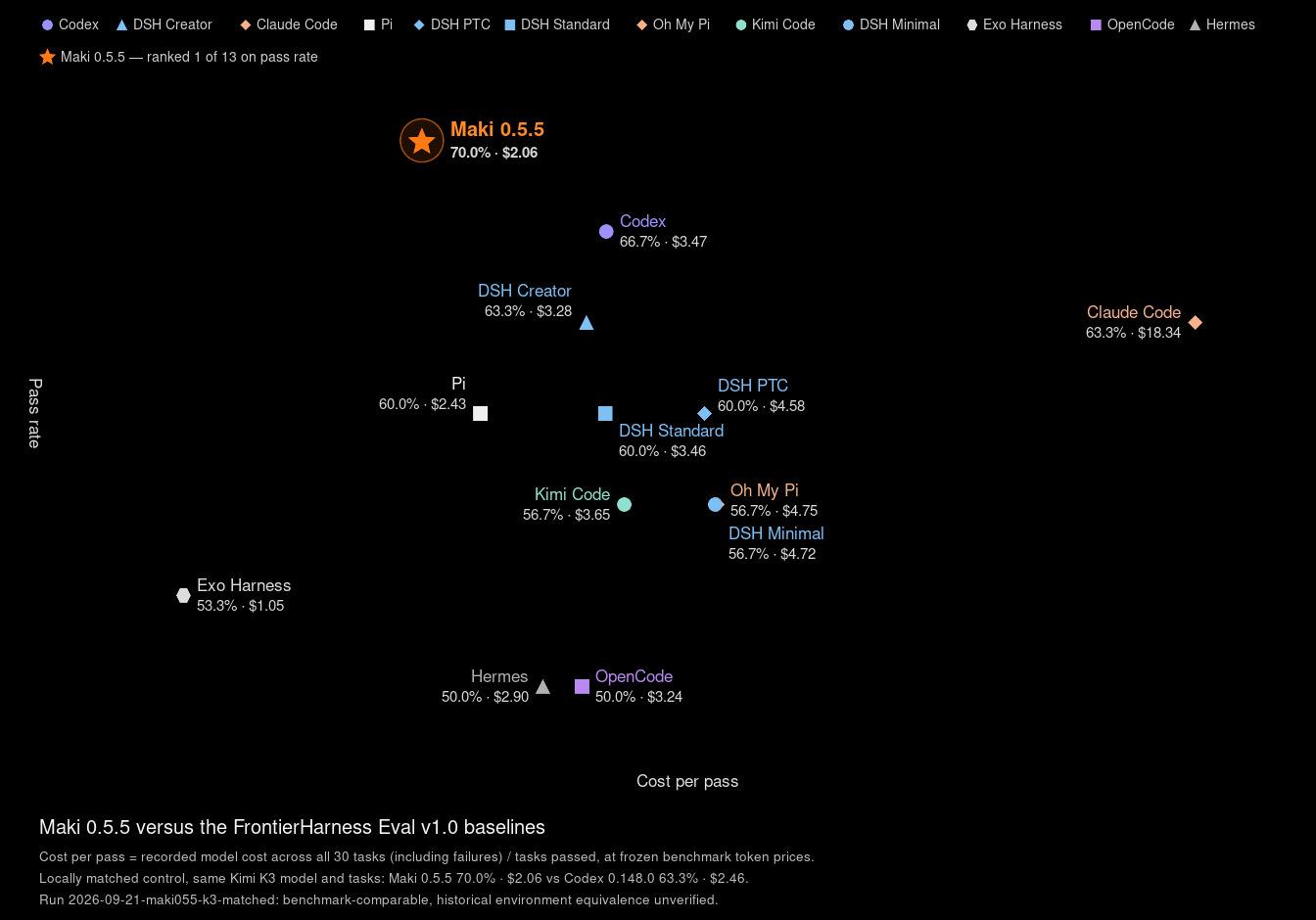
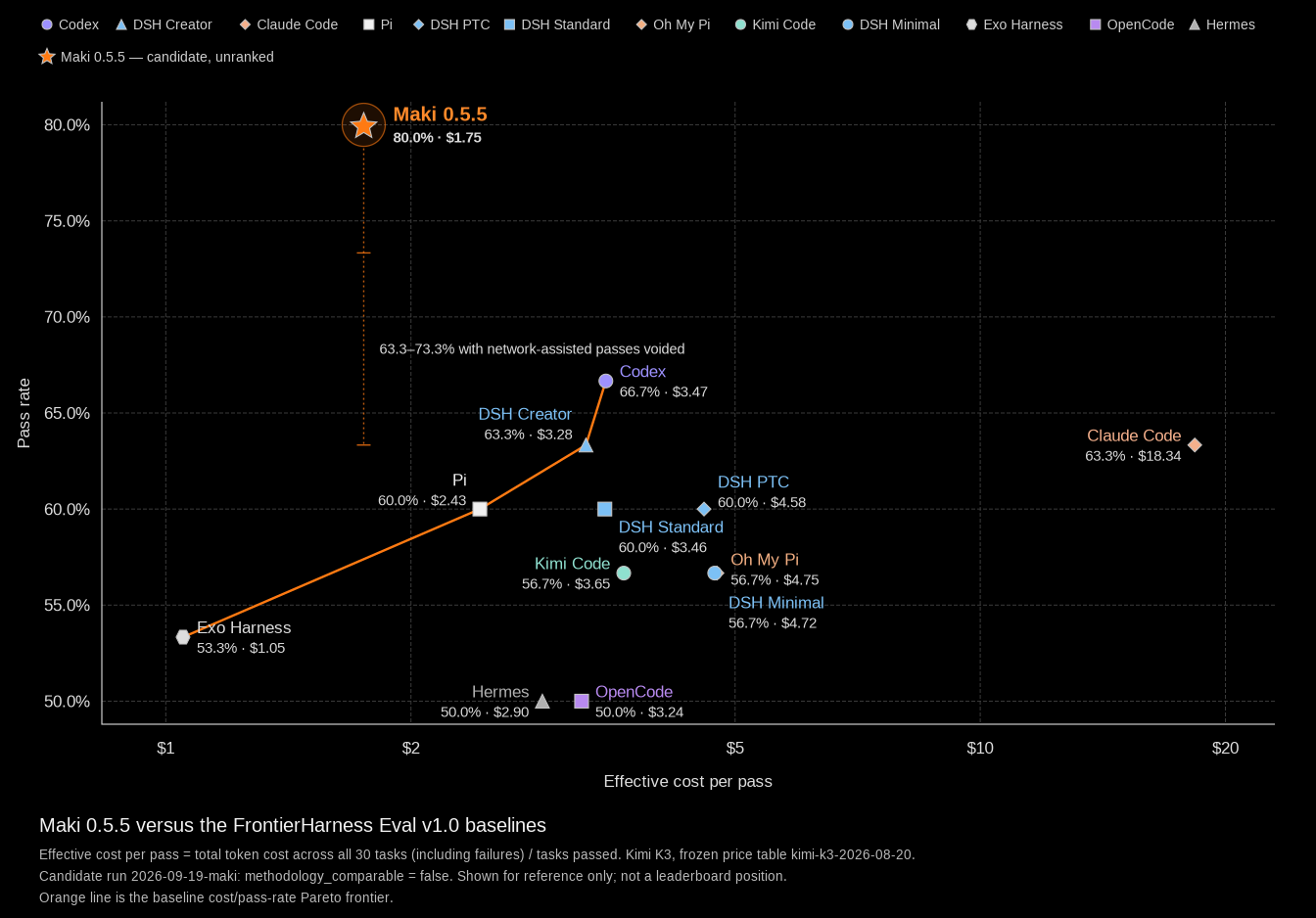
The Maki benchmark shows a promising cost per passed task, but its pass rate lead is too small to settle a ranking. Maki 0.5.5 passed 70.0% of 30 FrontierHarness Eval tasks at $2.06 per pass. The chart comes from the Maki project, so I treat it as a reason to test Maki myself.
| Harness | Pass rate | Cost per pass |
|---|---|---|
| Maki 0.5.5 | 70.0% | $2.06 |
| Codex | 66.7% | $3.47 |
| Claude Code | 63.3% | $18.34 |
| Hermes | 50.0% | $2.90 |
| OpenCode | 50.0% | $3.24 |
Read the sample size first. On 30 tasks, 70.0% is 21 passes and 63.3% is 19 passes, so two tasks separate Maki from Claude Code. My own 95% Wilson interval for 21 of 30 runs from about 52% to 83%, and it overlaps the interval for 19 of 30.
The chart documents one same-model control: on Kimi K3, Maki scored 70.0% at $2.06 and Codex 0.148.0 scored 63.3% at $2.46. That narrows the cost gap with Codex to 16%. The chart also states that historical environment equivalence is unverified, and it covers Maki 0.5.5 while the current release is 0.7.2, published on November 14, 2026. This is why cost per solved task needs a test on your own workload.
Can Maki use ChatGPT and Claude subscriptions without an API key?
Yes, Maki can use both, but the two routes carry different risk. ChatGPT login is built in through maki auth login openai and needs no plugin. Claude Pro or Max login needs the community plugin maki-claude. It works, and I used it for my measurements, but I do not recommend it.
| Access route | Maki | OpenCode | My view |
|---|---|---|---|
| ChatGPT Plus or Pro | Built-in OAuth login | Documented “Sign in with ChatGPT” | Usable in both tools |
| Claude Pro or Max | Community plugin | Refused by a maintainer | Possible, not recommended |
| API key or local model | Supported | Supported | Safest way to evaluate |
Warning: the maki-claude plugin reuses the Claude Code OAuth flow and sends the Claude Code identity line so that Anthropic accepts the subscription token. Anthropic’s legal documentation says subscription OAuth is “designed to support ordinary use of Claude Code and other native Anthropic applications”, and that Anthropic may enforce its restrictions without prior notice. You could lose access to your account. I took that risk on my own account, and you should not copy it without reading those terms.
OpenCode’s position confirms that this is more than a technical gap. Asked to support Claude Code OAuth credentials, a maintainer answered “We cannot legally support this.“
What changed in my autonomous goal loop?
My goal loop went from ten single-vendor rounds per issue to seven rounds across two vendors. GPT-6.2 Sol now implements the first two rounds, Claude Opus 5.5 reviews them at high effort, and Opus 5.5 at medium effort handles the remaining rounds. I reformatted both prompts for readability, and the instructions are unchanged.
Steps shared by both loops:
/goal until no GitHub issue is labeled ready-for-agent

Each cycle:
1. Pick up to 2 ready-for-agent issues from different areas, highest priority first.
2. Use subsessions to run /implement in rounds (limits below).
3. Stop early when code review reports 0 findings.
4. Commit at each round.

When an issue is finished:
5. Open needs-triage issues for any leftovers.
6. Update the changelog, merge the PR and close the issue.
7. Clean local and remote branches and worktrees.
8. Resync the local branch.

Compact the session every 2 issues.
Before, in Claude Code, up to 10 rounds per issue:
Rounds 1 to 5    implement    effort medium
Rounds 6 to 10   implement    effort high
Copy the full “before” command
/goal until no GitHub issue is labeled ready-for-agent, do: Pick up to 2 ready-for-agent issues from different areas, highest priority first. Use subsessions to run up to 10 rounds of /implement per issue, and stop early when code review reports 0 findings. Commit at each round. Rounds 1 to 5: implement with effort medium. Rounds 6 to 10: implement with effort high. When an issue is finished: open needs-triage issues for any leftovers, update the changelog, merge the PR, close the issue, clean local and remote branches and worktrees, and resync the local branch. Compact the session every 2 issues.
After, in Maki, up to 7 rounds per issue, with subsessions launched through the maki-subsession skill:
Rounds 1 to 2    implement    OpenAI:gpt-6.2-sol                       effort high
Rounds 1 to 2    code review  Claude-Subscription:claude-opus-5-5-1m   effort high
Rounds 3 to 7    all work     Claude-Subscription:claude-opus-5-5-1m   effort medium
Copy the full “after” command
/goal until no GitHub issue is labeled ready-for-agent, do: Pick up to 2 ready-for-agent issues from different areas, highest priority first. Use subsessions to run up to 7 rounds of /implement per issue, and stop early when code review reports 0 findings. Commit at each round. Rounds 1 to 2: implement with OpenAI:gpt-6.2-sol at effort high, and run code review with Claude-Subscription:claude-opus-5-5-1m at effort high. Rounds 3 to 7: use Claude-Subscription:claude-opus-5-5-1m at effort medium. When an issue is finished: open needs-triage issues for any leftovers, update the changelog, merge the PR, close the issue, clean local and remote branches and worktrees, and resync the local branch. Compact the session every 2 issues.
| Parameter | Before | After |
|---|---|---|
| Harness | Claude Code | Maki |
| Claude weekly limit used in 12 hours | 17% | 5% |
How much of the 17% to 5% drop comes from Maki?
I cannot isolate Maki’s share of the 71% drop in Claude weekly usage. I changed the harness, the vendor mix, the round limit and the effort levels at the same time. Moving implementation to OpenAI also shifts part of the work onto my ChatGPT plan, so some of that Claude saving is displaced usage.
The operating result is still clear. At 17% per 12 hours, a loop running all week would need 238% of the weekly limit. At 5%, the same schedule needs 70%. The 17% loop stalls after about three days, and the 5% loop runs the full week with margin.
These figures cover Claude weekly usage only. They do not count ChatGPT quota, and they are not normalized per closed issue. A rigorous comparison would replay the same issues while changing one variable at a time.
Do model vendors have an incentive to burn tokens?
Model vendors sell tokens, so a vendor harness has no direct commercial reason to minimize them. That is an incentive, and I have no evidence of intent. Reading more context can also improve results. My hypothesis is reasonable to hold, and the practical answer is to measure token use per completed task across harnesses.
How should you test Maki on your own workload?
Test Maki on a fixed set of real issues, with the same model and the same acceptance checks as your current harness. If you use OpenCode, or Claude Code in the terminal, this test is worth an afternoon. Use an API key, a ChatGPT login or a local model, and record cost per merged change.
- Pick five to ten closed issues that represent your normal work.
- Move your team rules from prose into lint rules, tests and CI.
- Run each issue in your current harness and in Maki, with the same model.
- Record tokens, cost, review rounds and whether CI passes.
- Change the model split only after you have the harness result.
If you do not use a structured workflow yet, start with Matt Pocock’s skills or pstack. Process gives the harness comparison something stable to measure. My guide to AI infrastructure and SRE applies the same cost-per-task discipline to models in production.
FAQ
How can I reduce Claude Code token usage?
Reduce Claude Code token usage by starting fresh sessions for each unit of work, moving prose rules into linters, tests and CI, limiting review rounds, and sending routine work to cheaper models. Measure usage per completed task, because a lower token count has little value if more tasks fail.
What is Maki?
Maki is an open source AI coding agent written in Rust and extensible with Lua plugins. It limits context usage with code skeletons, sandboxed code execution, on-demand tool loading, subagent model tiers and session compaction. It works with providers such as Anthropic, OpenAI, OpenRouter, Ollama and llama.cpp.
Is it safe to use a Claude subscription in Maki?
Using a Claude subscription in Maki is possible through the community maki-claude plugin, but I do not recommend it. Anthropic’s documentation reserves subscription OAuth for Claude Code and native Anthropic applications, and Anthropic may enforce its restrictions without notice. An API key is the safer way to use Claude models in Maki.
Does OpenCode support ChatGPT and Claude subscriptions?
OpenCode documents sign-in with a ChatGPT Plus or Pro plan instead of an OpenAI API key. For Claude subscriptions, an OpenCode maintainer closed a request to support Claude Code OAuth credentials with the statement “We cannot legally support this.” OpenCode users can still connect Claude models with an API key.
What is the difference between a Maki subagent and a subsession?
A Maki subagent is a fresh task inside the session, and it can only choose a weak, medium or strong model tier on the current provider. A Maki subsession is a separate non-interactive process, launched with the maki-subsession skill, that can use any provider and model configured in Maki.
Sources
- Matt Pocock, Skills For Real Engineers and AI Hero
- poteto, The Complete Guide to pstack Pt. 1 (August 31, 2026), post on code comments (October 13, 2026), post on trusting agent work (October 2026) and the pstack repository
- Maki website, provider documentation and benchmark chart, consulted November 18, 2026
- Maki tool documentation and my maki-subsession skill
- maki-claude plugin README
- Anthropic, Claude Code legal and compliance, consulted November 18, 2026
- OpenCode provider documentation and OpenCode issue 20079
The usage figures are my own readings from one side project. I have no commercial relationship with the projects cited. Emile Heitor is a personal friend.
Related posts
- AI Infrastructure and SRE: Running Models in Production
- Efficiency Is Not Raw Power: Meet GPT-6-Astra and the DeepSWE Reality
- Model Fusion Beats the Frontier Model. The Cost Case.
If your AI platform costs more than the work it delivers, my cost optimization review measures where the spend goes and what to change first.
0 Comments