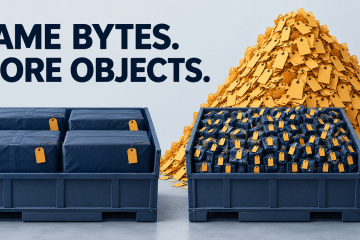
object storage
Object Storage for Data Platforms at Scale
Size an object store against bytes, object metadata, request demand and maintenance time. A practical worksheet for small files, retention, erasure coding and release-channel choices.
Size an object store against bytes, object metadata, request demand and maintenance time. A practical worksheet for small files, retention, erasure coding and release-channel choices.
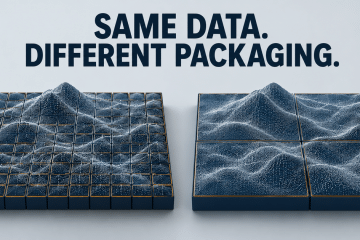
Compression, object population and request count measure different things. Compare point-cloud packaging, range reads, update costs and cleanup with an explicit synthetic sizing example.
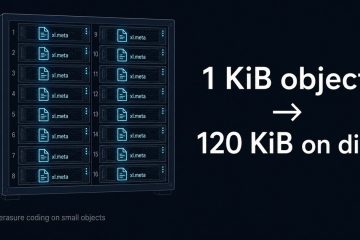
Two MinIO platforms, same root cause: used as a NoSQL store. Field notes on LIST IOPS, XFS directory limits, scanner & heal SLAs, the erasure-coding storage-efficiency inversion on small objects, and why Apache Cassandra (or Ceph) is the right answer on-prem in 2026.

Note: This article was inspired by a LinkedIn post by Can Sinan A. on the hidden operational cost of an Iceberg migration, especially when governance moves from one access-control plane to several layers: catalog, storage and engine configuration Introduction Many organizations are modernizing their data platforms with lakehouse architectures, and Read more

Migrating unmanaged OSDs is one of the operations I run for Ceph clients: Ceph storage consulting. If you are running Ceph Squid with a mix of managed and unmanaged OSDs, there is one thing worth stating clearly upfront: There is no in-place adoption mechanism in Squid. You cannot “import” an Read more

Introduction Benchmarking remains a critical (and often underestimated) tool when designing or validating large-scale data platforms. While many teams rely on synthetic workloads or production replays, standardized benchmarks still play a key role when comparing architectures, tuning clusters, or validating infrastructure choices. TPCx-HS is one of those benchmarks: designed to Read more
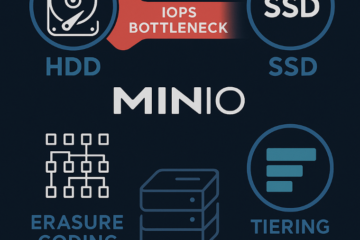
Hidden storage costs are one of the targets of a data platform cost optimization review. Bring the IOPS dude ! As a solutions architect working with MinIO storage solutions, I’ve seen firsthand the challenges that come with on-premises deployments using hard disk drives (HDDs). While HDDs may seem like a Read more
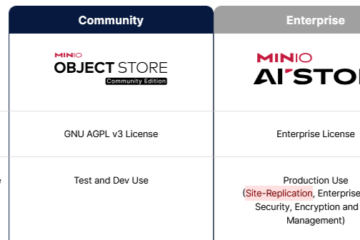
Beware the AGPL! you may end with a product orphan from its S3 storage… MinIO has long been a popular open-source S3-compatible storage solution, but their strategy has shifted dramatically, especially since the release of their new AIstor product, now positioned as their main enterprise S3 offering. Over the past Read more

MinIO has just announced that the open source project is now in maintenance-only mode: no new features, no regular PR review, only best-effort community support.If your data lake, AI workloads or internal S3-compatible storage rely on MinIO, this is no longer a theoretical risk: it is an operational one. Over Read more