Pepitedata
  • Home
  • Audits
  • Expert Call
  • About
  • Blog
  • Contact

object storage

Abstract illustration of multi-site object storage replication between data centers
MinIO

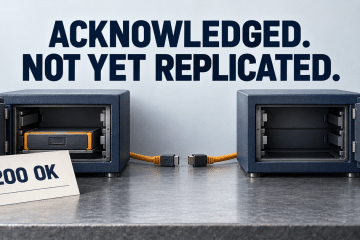
MinIO Site Replication: Sync Mode Will Not Save Your RPO

MinIO site replication has no cross-site quorum, and its replication queue exists only inside the source cluster: lose that site and the un-replicated backlog is gone and un-enumerable. Sync mode costs latency without fixing that. The precise model, the RTO/RPO table, and the DR patterns that match real SLAs.

By Julien Laurenceau, 5 hours ago
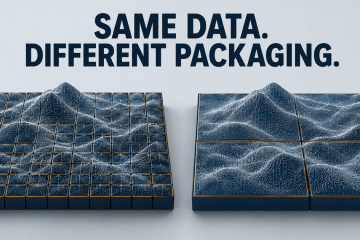
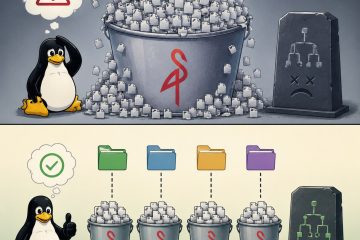
Two panels. Top: a single MinIO bucket overflowing with small files, a worried Tux, and a dead directory tree on a tombstone. Bottom: the same objects split across four prefix-partitioned buckets under separate folders, with a healthy green directory tree.
MinIO

MinIO on XFS: Inode Exhaustion and Prefix Design for Lots of Small Files

MinIO has no NameNode. It puts the namespace on XFS as real directories and xl.meta files. On Lots of Small Files that means you can exhaust inodes while df -h still looks fine, and a flat leaf can stall PUT, LIST, scanner, and ILM together. Here is the on-disk model, the inode math, and a prefix recipe that keeps XFS inside a regime you can operate.

By Julien Laurenceau, 1 week2026-07-27 ago
Erasure coding is efficient on big files but degrades to many inefficient copies on small files
MinIO

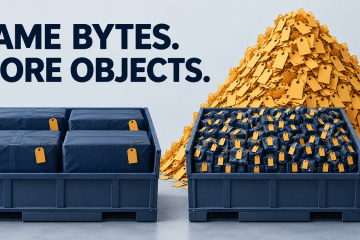
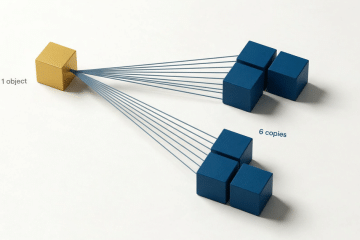
MinIO and Small Files: When Erasure Coding Becomes 15x Replication

MinIO fixed the HDFS NameNode limit, but it has no index: it writes one xl.meta per object on every drive of the erasure set. On 5 servers of 12 NVMe, MinIO picks a 15-wide set by default, so each small object is stored 15 times over. A worked sizing that looks fine for two years and dies in days.

By Julien Laurenceau, 2 weeks2026-07-23 ago
Diagram: MinIO erasure-coding storage inflation on small objects — per-drive xl.meta metadata replicated across the erasure set
data

Stop using MinIO as a NoSQL database — why S3 object stores collapse on small-file workloads

Two MinIO platforms, same root cause: used as a NoSQL store. Field notes on LIST IOPS, XFS directory limits, scanner & heal SLAs, the erasure-coding storage-efficiency inversion on small objects, and why Apache Cassandra (or Ceph) is the right answer on-prem in 2026.

By Julien Laurenceau, 3 months2026-05-17 ago
data

When the Lakehouse Works, but the Operating Model Breaks… Especially On-Premises

Note: This article was inspired by a LinkedIn post by Can Sinan A. on the hidden operational cost of an Iceberg migration, especially when governance moves from one access-control plane to several layers: catalog, storage and engine configuration Introduction Many organizations are modernizing their data platforms with lakehouse architectures. The Read more

By Julien Laurenceau, 3 months2026-05-04 ago
AI

Tesla’s .SMOL Format Shows Why Most Enterprise Data Lakes Are Architecturally Wrong

When Tesla published patent WO2024073080 describing a new file format internally called “.smol”, the headline was simple: 4x reduction in IOPS for AI training. Most people read this as a hardware story. It isn’t. It’s a data architecture story. And it exposes a structural weakness in how most enterprise data Read more

By Julien Laurenceau, 6 months2026-02-11 ago
apache spark

Apache Spark smoke tests on kubernetes

Introduction Benchmarking remains a critical (and often underestimated) tool when designing or validating large-scale data platforms. While many teams rely on synthetic workloads or production replays, standardized benchmarks still play a key role when comparing architectures, tuning clusters, or validating infrastructure choices. TPCx-HS is one of those benchmarks: designed to Read more

By Julien Laurenceau, 7 months2026-01-12 ago
data

The Hidden Costs of Using HDDs in On-Premises MinIO Deployments

Bring the IOPS dude ! As a solutions architect working with MinIO storage solutions, I’ve seen firsthand the challenges that come with on-premises deployments using hard disk drives (HDDs). While HDDs may seem like a cost-effective option initially, they can introduce significant performance bottlenecks that impact the overall efficiency and Read more

By Julien Laurenceau, 8 months2025-12-15 ago
data

MinIO’s Community Edition: The End ? 🚨

Beware the AGPL! you may end with a product orphan from its S3 storage… MinIO has long been a popular open-source S3-compatible storage solution, but their strategy has shifted dramatically—especially since the release of their new AIstor product, now positioned as their main enterprise S3 offering. Over the past year, Read more

By Julien Laurenceau, 8 months2025-12-15 ago
data

Who’s Using Ceph RBD Mirroring for Kubernetes Storage in Production?

Alpha Feature in Production… Good Idea? The most promising approach, journal-based mirroring, offers near real-time replication and faster failover. However, it’s currently an alpha feature in the Ceph CSI driver and relies on rbd-nbd, which introduces significant risks: For documentation on Ceph RBD mirroring see IBM documentation For details, see Read more

By Julien Laurenceau, 8 months2025-12-15 ago

Posts pagination

1 2 Next
  • Privacy Policy
  • Mentions légales
  • CGV
  • Cookies
Hestia | Developed by ThemeIsle