Download this article (PDF) 518 KB

A strong teacher can make post-training cheaper by supplying a richer learning signal. That does not mean every frontier model costs ten times more than every follower. Qwen3 reports a roughly tenfold GPU-hour difference in one Qwen3-8B comparison; the cost of discovering and training the teacher is a separate budget.
My working hypothesis is that followers can reuse both a demonstrated behavior and evidence about which approaches work. My background is numerical optimization, not training frontier models. I find the exploration-versus-exploitation framing useful for asking where the uncertainty sits, provided it does not replace the experiment or the cost model.
Revised October 22, 2026. The Qwen3 comparison is scoped to post-training, not total frontier development cost. This version removes the universal tenfold claim and the implied hard ceiling on students, and separates the optimization analogy from measured evidence.
What does the Qwen3 comparison actually show?
Table 21 of the Qwen3 Technical Report compares additional reinforcement learning and on-policy distillation on Qwen3-8B after off-policy distillation. It reports 17,920 GPU hours for the RL branch and 1,800 for the on-policy branch. The corresponding AIME’24 scores are 67.6% and 74.4%. This is a specific post-training comparison, not a complete model-development bill.
| Reported stage | AIME’24 | GPQA-Diamond | GPU hours |
|---|---|---|---|
| Off-policy distillation baseline | 55.0% | 55.6% | Not reported in this table |
| Baseline plus reinforcement learning | 67.6% | 61.3% | 17,920 |
| Baseline plus on-policy distillation | 74.4% | 63.3% | 1,800 |
The primary source is the Qwen3 Technical Report. The reported-hour ratio is about 9.96. It supports a substantial advantage in that setup, not a fixed dollar saving across different hardware, utilization, datasets or accounting boundaries. I would not use it to price another team’s training run.
Why can a teacher make learning more efficient?
A teacher can provide feedback on intermediate token choices rather than only a final outcome. On-policy distillation evaluates trajectories sampled by the student, so supervision reaches states the student actually visits. That can make correction more informative, but the benefit depends on the teacher, student and task. Teacher evaluation and rollout generation still consume compute.
Kevin Lu’s Thinking Machines Lab write-up explains this mechanism using per-token reverse-KL feedback. Its comparison with sparse outcome reward describes particular training signals, not every possible RL system. Process rewards and other supervision choices can change the contrast. Nor does token-level supervision mean the teacher supplies correct factual labels at every step.
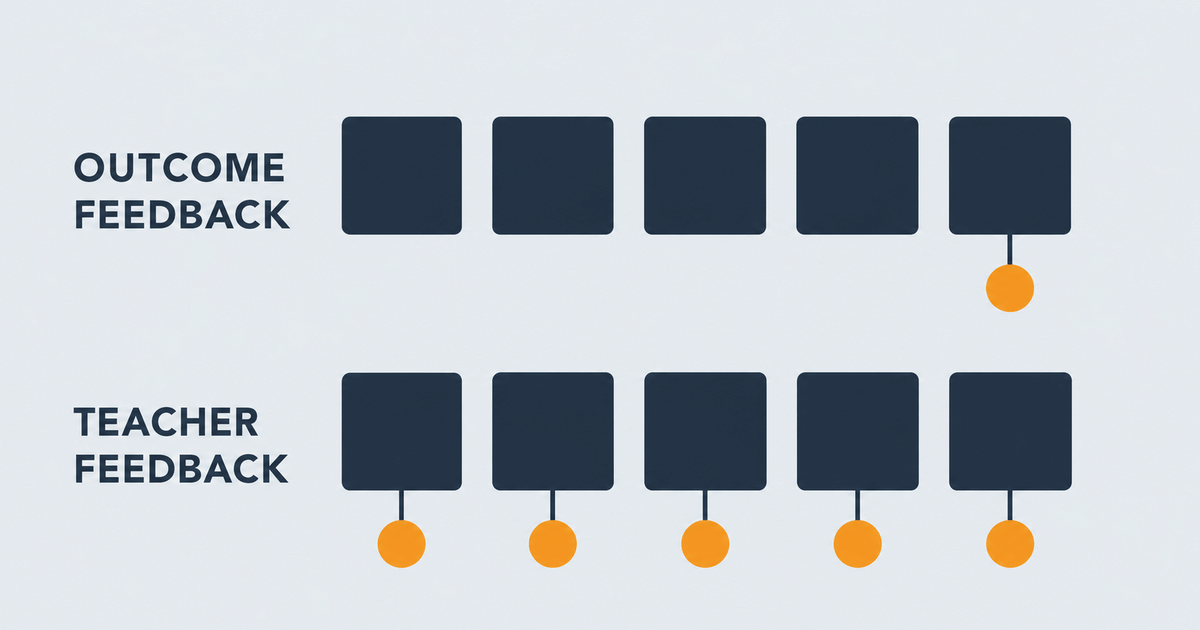
Distillation also does not require differentiating through the teacher’s weights. A practical question is what the training interface exposes: sampled text, token probabilities, or both. Those access modes do not supply identical supervision. A teacher that answers ordinary API requests is not automatically a teacher suitable for the intended on-policy recipe.
Exploration happens at more than one level
Exploration can occur in training trajectories and in decisions about data, architecture, rewards and evaluation. Both leaders and followers can use gradient-based weight optimization. The distinction is therefore not genetic algorithms versus gradient descent. It is how much of the problem is already specified and which useful signals are available before a costly run starts.
In numerical optimization, a useful starting point and an informative objective can save considerable work. That is the part of my background I bring to this question. I would not equate NSGA-II with frontier training or L-BFGS-B with distillation: their convergence behavior cannot establish an LLM training-cost ratio.
A leading lab can still use teachers, earlier checkpoints, specialists, synthetic data and verifiers. A follower can still discover a new method. The original title’s suggestion that the frontier has no teacher was too absolute. My narrower claim is that reproducing demonstrated behavior can remove some uncertainty that discovering a new capability does not.
What belongs in the distillation budget?
A distillation budget needs the data and initialization work, student sampling, teacher evaluation, training updates and validation. Serving the resulting model adds another set of costs. A GPU-hour figure for one stage cannot stand in for all of them. I would compare options using a stated workload and an accounting boundary that includes the dependencies each option needs.
| Budget component | What to measure | Common omission |
|---|---|---|
| Data and initialization | Preparation, validation and starting-checkpoint cost | Treating a prepared baseline as free |
| Student and teacher computation | Sampling, scoring, updates, GPU allocation and utilization | Counting student updates but excluding teacher scoring |
| Evaluation and serving | Held-out quality, retries, latency and operating cost | Assuming the training benchmark proves production suitability |

For capacity planning I would separate rollout generation from teacher scoring and student updates. They may have different memory, batching and throughput characteristics. Budget for unsuccessful experiments and revalidation too. A smaller deployed model can save inference resources without making the project that produced it cheap.
A student is not subject to a universal ceiling
Distillation aims to transfer selected teacher behavior, but it does not impose a universal theorem that a student can never outperform its teacher on any task. Data selection, specialization, other training signals and evaluation conditions can change the result. Conversely, matching a teacher on one benchmark does not establish the teacher’s full capabilities or reliability.
A useful procurement question is whether the student meets the actual acceptance criteria. The relevant result might be schema correctness, factual support, tool reliability or latency under load. A generic claim that a follower is several months behind the frontier does not answer any of those.
Epoch AI’s August 2025 consumer-hardware analysis reported benchmark-dependent lags of roughly six to twelve months and warned that real-world gaps could be longer. That was a dated empirical comparison, not a fixed nine-month law or proof that catching up is easy.
How I would evaluate the build-or-buy decision
I would choose between an API, distillation and an existing open model by evaluating the same workload against explicit quality and operating requirements. The decision should include permitted training access, data handling and the cost of keeping the result current. Neither frontier branding nor a small training bill establishes the best option for a particular product.
- Define acceptance criteria and a held-out workload before selecting a teacher or training recipe.
- Evaluate an existing smaller model and a hosted baseline. Avoid training a model to solve a problem already met by configuration.
- Verify the teacher interface, permitted use of outputs and data-handling constraints before budgeting the experiment.
- Run a bounded pilot and measure the complete compute path, including failed runs and teacher work.
- Test deployment quality, concurrency, memory and latency. Include monitoring and re-evaluation in the operating budget.
This is the operating perspective behind the AI infrastructure and SRE guide. I would rather see a modest model clear a demanding application test than use a headline training ratio as the business case.
FAQ
Training efficiency depends on the experiment, available supervision and accounting scope. Distillation is one way to reuse existing capability, while production suitability requires its own evaluation. These answers distinguish the reported Qwen3 result from broader hypotheses about frontier economics, and identify what must be tested before applying that result to another workload.
Does distillation always cost ten times less?
No. Qwen3 Table 21 reports a roughly tenfold GPU-hour difference for two post-training branches on Qwen3-8B. It does not establish a universal ratio for total development cost, dollar spending or another workload.
Do frontier labs have no teachers?
No. Strong models can learn from prior checkpoints, specialists, synthetic data and other supervision. Discovering new capabilities can require additional experimentation, but that does not mean leading models are trained without teachers.
Is RL feedback always only one bit?
No. A binary outcome reward is one example of sparse feedback. RL systems can use richer rewards and process supervision. The relevant comparison is the actual signal and training setup, not a universal one-bit rule.
Can I ignore the teacher’s compute bill?
Only if the stated accounting scope explicitly excludes it, and that exclusion remains visible. A project budget should account for teacher access or scoring and distinguish amortized dependencies from new expenditure.
Related AI model-economics guides
This article focuses on why a reusable training signal can change post-training economics and where that explanation stops. The related guides cover teaching mechanisms, the cost of a local-model project and combining model outputs. Each addresses a separate decision, and each still needs a workload-specific evaluation before it becomes a deployment recommendation.
- AI infrastructure and SRE
- How big models teach small models
- The cost of a frontier-to-local distillation project
- Evaluating model fusion
Sources checked October 22, 2026. Benchmark results belong to the cited authors; the optimization framing is my interpretation. Images are conceptual, not benchmark plots. No customer information is included and no affiliation or endorsement is implied.
If you are deciding whether to train and host a model, I can review the workload and hardware assumptions through Capacity Planning and Platform Sizing or a Flash Architecture Review. Book a free 15-minute intro call to discuss the decision.
1 Comment
digital mixtape · 2026-10-06 at 03:14
the ‘rider in front pays for the road’ line is such a clean way to put it. everyone argues about compute bills but framing the follower advantage as a denser signal is the part most takes miss. honestly the dense differentiable point clicked for me in a way the usual distillation talk never did.
the same logic works way outside ml too. nobody reinvents cd burning tech, they just move it into the browser so anyone can burn one without a drive, like a online CD burner. follower gets ninety percent of the value for a tenth of the effort. one thing i keep wondering though: once the leader rents its own frontier model out via api, is that the road rider charging tolls, or does the gap actually narrow from there?